Saturday, September 9, 2006

Water-less Beijing


Beijing has invested billions of yuan in massive projects to increase and improve its water supplies, but with a new initiative to change how the public uses the wet stuff – from raising the prices of water to promoting cutting edge toilets – do we sense desperation?

The driest major city in the world keeps getting drier, with an annual reserve of about 300 cubic meters of water per person; an acute shortage is generally considered to be 1,000 cubic meters or less. 2006 marks the eighth consecutive year of drought in the North China Plain, the longest drought since the founding of the People’s Republic according to the State Environmental Protection Administration (SEPA). “It’s as bad as Israel,” says Ma Jun, the president of the Institute of Citizens and the Environment. “It’s hard to be optimistic.”

“They are moving in all directions now, including the right ones,” says Christoph Peisert, a conservation expert with the German Agency for Technical Cooperation, who advises the government on water management. “But there’s not yet enough public interest in reducing the waste of water.” Last month, Ma Weifang, an official with the city’s sustainable development promotion committee, said that based upon the city’s current water consumption and efficiency levels, Beijing could face one of the worst droughts in its history at the same time as hosting its “Green Olympics” unless citizens learn to curb water consumption and use recycled water more efficiently.

To encourage these steps, the Beijing government in May issued its tallest water orders yet: It has promised to investigate water usage at construction sites, golf courses and saunas, imposing fines of up to RMB 10,000 if necessary. There’s also a mandate to install water-saving faucets in Beijing’s households. Recycling water is another strong focus, especially at car washes. While one car wash tbj visited was already using recycled water, no worker, or any other Beijing residents we’ve surveyed had heard about the recent water-saving campaign. Ma says, “At the moment, when they open the tap, they don’t realize what the effects are.”

While water consumption has reached a tipping point, Ma points out that the government’s conservation efforts can only do so much to ease the city’s shortage. Diminished ground water, for instance – which has caused Beijing to sink 10cm per year, reportedly threatening the stability of the new, heavy Olympic venues – can only be countered by improved irrigation and continued rainmaking, says Wen Bo, a local environmentalist. “Right now the government seems to have no way out.”

Replenishing the city’s water resources will require an even greater effort. The government recently announced plans to divert water from a Yangtze River tributary, which lies 1,200 km away from Beijing and whose polluted waters are an environmental concern. “I don’t see so many problems with the idea,” says Peisert, with a tone of resignation. In any case, it’s clear that further efforts need to be made to address both China’s ongoing environmental problems and the capital’s chronic water shortage – never before has a new water efficient toilet sounded so good.

(from the August 2006 issue of that's Beijing)


On the Road Again: Ma Jian | Stick Out Your Tongue

Ma Jian envisioned Tibet as Nirvana. The book he wrote after his journey offers a darker vision

In 1985, writes Ma Jian, he headed from Beijing to Tibet hoping to "work out what I should be doing with my life." Ma, like so many discontented romantics, envisioned the Himalayan land as a spiritual refuge from the modern world. But it was just a dream. What he discovered instead was a place whose heart had been ripped out. The few temples that remained after years of cultural and political purges by the Chinese government were guarded by soldiers and littered with slogans instructing allegiance to the Communist Party. The Dalai Lama had been exiled for more than three decades, and those who had stayed behind seemed consigned to a ruined fate.

In an afterword to Stick Out Your Tongue, a newly translated collection of short stories he wrote following his three-year journey to Tibet and other far-flung parts of China, Ma says he returned home more confused than before, feeling "as pathetic as a patient who sticks his tongue out and begs his doctor to diagnose what's wrong with him."

The diagnosis from Chinese officials, when Ma's book was released in 1987, was that his treatment of Tibet was "filthy and shameful" and had "nothing to do with reality." Every copy was ordered to be destroyed. But the collection quickly became a hit among the samizdat set; some enterprising black marketeers even copied it out by hand. Ma, who had once worked as a government propagandist, thus found himself forced into hiding. After stints in Hong Kong and Germany—with the occasional secret return to Beijing—he ended up in London, where he wrote a superb memoir, Red Dust, which appeared in translation in 2002. Where that narrative bounces along China's dusty roads and industrial backwaters like a better, eastern On the Road, the five short stories in Stick Out Your Tongue paint a more meditative portrait of a land that barely seems to move at all.

That's not to say the book isn't moving. In cool, spare prose, Ma powerfully conveys the double dislocation at the heart of his stories: a people estranged from their own home are described in four of these tales by the same Ma-like narrator, a dissident writer whose own life has been uprooted, too—not only by cultural crackdowns but by a string of failed loves. A Han Chinese in a land where the Han are despised, he has abandoned any fantasies about Tibet's peaceful locals: instead of sticking out their tongues—a customary greeting in Tibet—they throw stones at him. The glistening lakes and wide plateaus of central Tibet—where we find the narrator at the start of the hypnotic opening story—offer no solace either. Potentially sublime rustic experiences are tainted by brackish water or the stench of manure and animal hides. The narrator's hunt for enlightenment has already ended, and the traditional Buddhist sky burial of a young woman beaten to death by an abusive father is little more than an exotic photo-op. Just as the ritual of dismemberment ends, when "every piece of her had vanished from the site," the emotionally distant narrator remembers his appointment to go fishing with the woman's former lover.

The mistreatment of women by men is a common theme in all five of these stories. Beneath Tibet's enchanting surface, suggests Ma, lies the reality that its women are routinely forced into marriage, sex, prostitution and drugs. Yet Ma's bleak descriptions of their lives are not without a dreamy—though somewhat perverse—sense of redemption. A feisty, unfaithful wife burns and withers on a bronze stupa that her husband has built, only to be rolled up by her lover and devotedly draped on his wall. The final story—the tale of a young female monk forced by her elders through abusive rituals of spiritual enlightenment—ends the book as it began, with a beleaguered corpse that again seems to disappear, magically, into the scenery. This time, however, the woman isn't destroyed but transmuted like a bodhisattva, her body transparent: "A fish that had somehow gnawed its way into her corpse was swimming back and forth through her intestines." The narrator, who buys the woman's skull as a souvenir and hopes to sell it to finance his travels, writes her story "in the hopes that I can start to forget it," but the memory will not disappear.

Nor will the impression left by Ma's book, with its captivating blend of despair and hope, violence and dark humor, death and regeneration. In Ma's ambivalent portrayal, Tibet is as uneasy a place to live as it is to describe, and Tibetans possess a nuanced humanity often denied them—on the one hand by the idealized fancies of the Western imagination, and on the other by the Chinese government's oppression. The tongue of the book's title, then, is not only a reference to the traditional Tibetan greeting, but a complex symbol of ridicule and illness and vulnerability—and an invitation to see inside Tibet's dark mouth some precious signs of life.

From TIME asia Magazine, June 26, 2006 Vol. 167, No. 25

Saturday, August 26, 2006

Who Needs Friends When You Have Money?

A salesperson robotically waving a wand that distributed a light mist, another dispassionately demonstrating a spinning top to a couple of curious African men, two of a handful of customers, while a television showed a program about the Olympics. On display were jade sculptures, silky qipao, a paltry assortment of tea, and a selection of benign English-language paperbacks. All the typical tchotchkes of friendship – that is, diplomatic, state-sanctioned friendship: business as usual at the Beijing Friendship Store.

Just when things couldn’t look any more stereotypical, the ever-ebullient Mark Rowswell – known to television audiences as Dashan – strolled off the escalator and onto the second floor. Somehow it made sense: China’s most famous laowai shopping at Beijing’s most famous laowai institution.

Built in 1964, the Friendship Store catered exclusively to tourists and diplomats, who could find along its aisles some of the Western goods and souvenirs that were unavailable in other state-run shops. State media have announced that by the end of the year, the store will be torn down to make room for two office towers, a serviced apartment building and a new eight-floor department store. Dashan was undisturbed on hearing the news.

Developed in part by Macau-based casino impresario Stanley Ho, the new complex is supposed to be finished in 2009, at a price tag of around RMB 4 billion. That’s about RMB 4 billion more than the store made in 2005, when it took home a net profit of RMB 79,200; an improvement over a loss of more than RMB 3 million in 2004. The planned-economy, Soviet-styled relic – with its famous Soviet-style customer service – just hasn’t been able to keep up in the unfriendly free market of modern Beijing.

Didn’t the store at least have the market cornered when it came to friendship? China’s top foreigner let out a chuckle and delved into the history of “friendship.”

“In the ’60 and ‘70s, ‘friendship’ meant ‘preferential treatment’ or ‘cheap,’ and had the connotation of a kind of third world brotherhood,” he explains. “But ever since the late ‘70s and early ‘80s, as a foreigner in China you’d always avoid anything with the word friendship on it,” because it meant paying an inflated price.

Alex Pearson, a Beijinger since 1982, remembers when the Friendship Store was an oasis of convenience. “We could find things like milk, yogurt and cheese, and Walkmans, radios, Hi-Fis …”

Lynn Gan, Rowswell’s wife, remembers the store differently. As a Chinese person “you had to have some kind of connection to come in here,” she said of the days when the store required that customers have foreign passports and Foreign Exchange Certificates as currency.

A cheery young sales clerk acknowledged the store could use an upgrade, but with some regret in her voice. “It’s going to become stricter,” she said of the management.

Would the new Friendship Store at least be friendlier?

She thought about it for a moment. “It’ll probably be more expensive.”

from the August 2006 issue of that's Beijing

Tuesday, August 15, 2006

Towering Ambitions: An Interview with CCTV Architect Ole Scheeren


Ole Scheeren of OMA is driving the world’s largest architectural project, Beijing's CCTV+TVCC

by Alex Pasternack
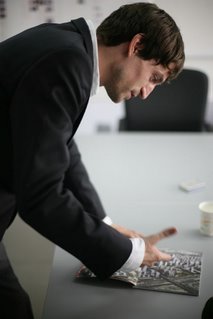

Important architects tend to look and sound as ostentatious as their designs, which is why you may not immediately recognize Ole Scheeren. The angular 35-year old German was sitting in a coffee shop in the Central Business District recently, wearing a shirt with an open collar, a pair of jeans, a day-old beard on his schoolboy face, and none of those self-consciously eccentric glasses by which architects are sometimes known. Discussing his latest project, his speech was unassuming, thoughtful, and curious; he even arrived early. He hardly seemed, in other words, like the lead designer behind the CCTV Tower, the hulking loop of a building that, two years from completion, has already become both Beijing’s controversial new icon and the world’s biggest architectural marvel.


“If you would preoccupy yourself with feeling so great about what you’re doing, there is an implicit loss of criticality vis a vis what you’re doing,” he says in his light, clean European accent about CCTV going to his head. “And in the case of this project it would be a fairly fatal to the momentum. It requires total attention at every point at time. There’s very little time to think about it.”

Nor does the project give Scheeren much use for the sort of rhetorical flourishes for which architects, like his famous Dutch mentor and co-architect on the project, Rem Koolhaas, are sometimes known. And when Scheeren does say things like “this may be the most complex building ever built,” he’s not kidding.

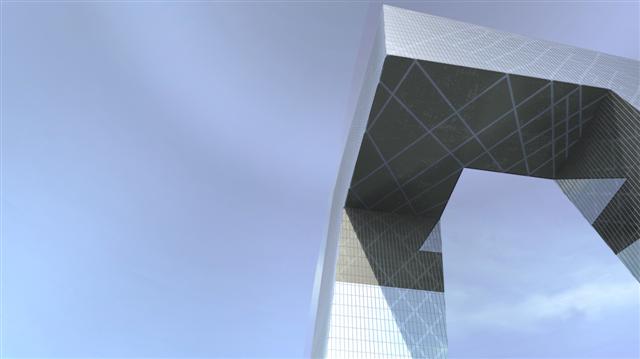
Since it was approved in an orgiastic moment of development in 2002, the 450,000 square-meter glass and steel China Central Television headquarters literally twists the conventional skyscraper into a gravity-defying three-dimensional trapezoid in the impossible style of M.C. Escher. Nearby sits a companion building, the public-oriented Television Cultural Center (TVCC), which resembles a cubist boot. They’re a feat of architectural gymnastics (and careful diplomacy) that has left many confused, worried, or downright disbelieving. One might just be just as incredulous about the architect’s age.

“Being 35, in a lot of professions, you’re a grandfather already, but in architecture you’re seen as being young,” he says. Raised by an architect-father, and harboring building aspirations early on, “in a way I have the feeling that I started quite early, so I don’t feel quite that young anymore.” But, how prepared could he be to manage a team that at one point exceeded 400 architects and engineers? When I marveled aloud that this project would be the biggest, in terms of scale, that he or OMA had even built (his last project was a triplet of Prada stores in New York, Los Angeles, and San Francisco), he replied with a slight grin: “Actually, it’s one of the largest buildings ever built.”

Scheeren isn't worried about his relative lack of experience. “First, you have to ask what type of experience is relevant to run a project like this. It’s a project that exceeds the scale of anything done so far, and so experience is not valid in the traditional sense,” he says, without a note of pretension. “And it takes an enormous energy that you can hardly generate in your 60s,” an age group that Koolhaas recently reached.

“The point is to say you don’t know how it works, and don’t know how the context works, and to develop a structure that allows change within the process.” It turns out that that sort of radical thinking informed the design all along, from its hastily-imagined loop to the lattice external steelwork that supports the building. But such uncertainty—and at such cost, with an initial reported budget of $700 million—didn’t sit well with either critics or the authorities. A year after a contract was signed, the government ordered a review of all new buildings, and (so rumor went) the television building was to be taken off the air. For one and a half years, the CCTV construction site sat untouched. When the cranes rose again, following a rigorous official review, the budget had reportedly grown to $1.2 billion. But Scheeren wasn't fazed.

“The thing is, we never stopped working on the project,” Scheeren says. Continuing work in offices in Beijing, Rotterdam and London not only helped to maintain the schedule, Scheeren maintains, but also preserved precious morale, which is hard-won in a profession so vulnerable to the kind of political shifts and opaque bureaucracies which are rife in China.

But Scheeren also acknowledges that such a daring design could not have been undertaken anywhere but in Beijing, with its racing-car economy and cosmopolitan aspirations. This is not to indicate that China is a “wild east,” a vertiginous playground for foreign architects to test-drive their imaginations, he says. “I find that repulsive.” On the contrary, China’s progressive architectural vision and ambitious plans have placed on the architect a particular burden and opportunity: nothing less than helping usher in a kind of revolution-through-design. “It’s not a condition you can take lightly,” he says of building in China. “It’s a chance to make yourself part of a progressive environment.”

To be sure, the CCTV project—with its radical shape, recreation areas named the “fun belt” and the “fun palace,” and a section specially designed for visitors—seems an unlikely undertaking for one of the world’s largest propaganda machines, and a government famous for concealment. This (disturbing) irony hasn’t gone lost on Scheeren. Indeed, he practically revels in it.

“[Building] CCTV was seen from the beginning as a tool for change from inside the company,” he says, alluding to a cadre of risk-taking “younger people leading CCTV, lying beneath the skin of the older generation,” who championed the design. When he talked about the building recently at an exhibition in its honor that he curated at the Courtyard Gallery and soon to move to New York’s Museum of Modern Art, Scheeren practically avoided discussing the design, focusing instead on what the building’s open layout might mean to the everyday Beijinger, and for a 21st century China. “It’s a change that exists beyond the realm of architecture. I’ve always been interested in that.”


Indeed, dramatic change and breadth have been the motif of Scheeren’s work as much as his life. It was an early introduction to the profession through his architect-father and his first commission at age 21 that initially burned him out. For a while, playing rock music seemed more appealing. “You’re so close to it, it’s uncomfortable,” he says of his architecture pedigree. Things changed when he heard a presentation by Rem Koolhaas, whose own interests beyond architecture (he had once been Holland’s most promising young screenwriter) reignited Scheeren’s interest. “I realized that someday I wanted to work with him.”

After butting heads with teachers at the design academy in his home town, the south-west German city of Karlsruhe (“They were impressed but not in a pleasant way…At the end of the year, all my models were destroyed with the excuse that they fell off the shelf”), Scheeren decided to continue his studies in London. On the first day of school however, he found himself driving to Rotterdam, where OMA’s main office is located, in a friend’s borrowed car. It mattered little that when he woke up at a local youth hostel, he found his car ransacked: he marched over to OMA with all that remained, the clothing on his back and his portfolio.

“In retrospect, it’s hard to figure out how it all happened,” he says as he stares at the table, slightly smiling. “Maybe I had the feeling that I had nothing else to lose.” Koolhaas threw Scheeren onto a project that seemed on the verge of failure, with two weeks until deadline. The 18­-hour days paid off, he says proudly. “It was the only competition oma had won in a year and a half.”

But the restless Scheeren left OMA almost as quickly as he had arrived, taking a graphic design gig in New York, and reenrolling at school in London. But he stayed in touch with his mentor-cum-colleague Koolhaas. When the designer Muccia Prada called on OMA to design some new boutiques in the U.S., Koolhaas called Scheeren. “I never wanted to go back to Rotterdam,” he says, “but the project was so intriguing.”

When OMA bid on the CCTV project in 2002 (declining an invitation to make a proposal for Ground Zero), Scheeren made his biggest shift yet, from designing clothing boutiques to constructing one of the largest buildings in the world.

Having relocated to Beijing that year, Scheeren discovered that the first challenge was figuring out how to explain the wacky design. The initial model for the building, which, cast in plaster, looked more like a deranged sculpture than a television headquarters, proved unimpressive to some of CCTV’s leadership. “It’s a very direct, literal culture and that’s an issue that you have to deal with when you enter the realm of conceptual issues,” Scheeren says. He and Koolhaas scrambled to build a more literal, transparent model, and weeks later a contract was signed.

Aside from not having enough time to study Chinese (“it’s the biggest frustration of being here… My plan is that before the building is finished. I need to get a whole step ahead”), Scheeren is still adapting to the process of constructing buildings in China, which “at such a breathtaking speed, cannot happen in a fully coherent matter.” But he hopes to inspire some change, too.

“I think part of the role of architects coming to build here is not only to bring a different sense of design but to try to step back and urge them,” planners, developers, clients and contractors, “to open up more lines of communication.” Scheeren says he aims for slower, careful consultations when proposing projects, like his successful bid for a new Beijing Books Building and a Prada “epicenter” store in Shanghai (When we met, Scheeren said OMA’s chances to renovate the stock exchange in Shenzhen were “promising.”)

Though the CCTV Tower’s exterior design work is essentially complete, and the first floors have started to peek above the scaffolding, Scheeren and his 20-person Beijing office have shifted to working on the building’s interior. And then there’s the job of still convincing people that the building is actually going to be built.

“Many people still don’t believe it’s going to happen,” Scheeren says, with some exasperation, but also a bit of delight. The truth is, neither can he.

“You think it can’t happen. And then you finally see the piles being driven into the ground, and the steel rising,” he says, with a faint smile. “These are the only moments that you believe that it is really happening.”


a version of this article was published in that's Beijing Home magazine (tbjHome), August 2006

Tuesday, June 6, 2006

Russian Doll : Regina Spektor

It's an old story: Wide-eyed nine-year old Jewish girl flees Russia to the shores of New York with her parents, who barely make ends meet while she passes her time exploring their Bronx neighborhood, the old Tin Pan Alley, and the piano keys — a remnant from years of practice in the old country and exposure to the classics (Chopin but also Pushkin). Soon, the setting becomes a downtown Manhattan nightclub, and she's stringing ragtime ballads, jazz standards, folk renditions, energy and vaudevillian pizzazz across the keys. Sheer talent plus a twist of fate would attract the attention of a snazzy producer and a wealthy band of patrons and ta da: Our heroine enters a world of minor celebrity nearly as surprising and strange as her musical narratives.

"We stopped at this truck stop in Colorado, and I'm in the fucking Subway, and there was a girl there getting a sandwich," Regina Spektor recounts a few weeks ago, using the f-word in the most excited, innocent way possible. "I saw her staring and she saw me and I thought about going up to her, but I thought maybe she was just staring, you know, didn't know who I was. Well. I got on MySpace today and someone wrote ‘I love your music and I smiled at you in the Subway.' I mean, wow."

Regina Spektor is running into fans in the strangest places; she's playing sell-out shows in the English countryside; she's getting written about on a hundred message boards and websites; she's on the phone from a hotel room at her latest tour stop, San Francisco. She also has a new album on a major label, Begin to Hope, a follow-up to 2004's Soviet Kitsch. It was a rough version of the latter that first pricked up the ears of the Strokes, who invited her on tour with them, and their producer, who recorded Kitsch. Almost three years later, and 17 years after fleeing Moscow, wow is still very much the theme. When on stage, perched on the edge of her stool, playing with her hands, chatting, the 26-year-old SUNY Purchase graduate still seems amazed, impressed, perplexed by it all, as if she's still learning something big from the crowds fawning over her.

"I can't imagine that kind of devotion, it's really beautiful," she says of the dedication which pushed fans across multiple states to see her play in Colorado in early May. "I played a show in Scotland where kids said they flew from Australia. In Bristol, people had come from Berlin," she says. The curly-haired Russian Jew from the Bronx with real estate on MySpace is trying to figure out where she is, and why people would bother coming that far. "I don't even know how to drive."

When she gets behind the keyboard however, Spektor could hardly sound more in control. From her measured debut, 11:11 through the more fanciful Songs and through the rich Kitsch, Spektor's fingers have learned to dance in jazz and pop and blues rhythms — occasionally parting ways to handle a drumstick on the nearest chair — with a precision matched by a voice that soars and halts aspirated, speaks in tongues and Russian and French and New Yawk accents, raps and, when a chair isn't available, carries the percussion too, beatbox style. On "Twenty Years of Snow," a new song that imitates a Polish mazurka, Spektor's plaintive minor chord progressions twinkle rapidly beneath a voice that ranges from fragile to breathy to speak-y before rolling into a rap that beckons a bop interlude before the recapitulation, where she stutters it all to a close. Such idiosyncratic stylings have earned her the fad label "anti-folk," along with comparisons to Tori, Bjork, Norah, Fiona, Ani and Joni. While perhaps flattering, these names don't do much more justice to Spektor's style than, say, likening her to Ronnie Spector. "Associations are associations," she shrugs, "but I definitely feel like my songs are my songs."


Whereas the adventurous vocal experiments of Soviet Kitsch could sometimes border on preciousness, Spektor's verbal tics on Hope — grunts, breaths, word-bendings and so on — become neater devices for her four-minute fables. The addition of electric guitar courtesy of The Strokes' Nick Valensi and the machinery of producer David Kahne even uncover a new, upbeat poppiness ("Fidelity," "Better," "Hotel Song"), while making room for even more improvisational tricks (see the Billie Holiday tribute "Lady" and the funky admonition "Edit"). Spektor recalls her reaction to first hearing a finished Hope: "I was like, ‘I love you, record." While she only had two weeks to record Soviet Kitsch, Spektor had a leisurely two months for her latest. "It's the first time in my life where I'm so excited that I want people to hear it, where I'm not giving a record to people with a disclaimer that it's not what I wanted it to be. I made it how I wanted to make it."

When asked about what inspired the record, Spektor characteristically points to nothing smaller than the world. "It's so diverse, it's a dream for anybody documenting anything. It's here! The world, write it down!" Her reluctance to talk shop is less a sign of coyness than honesty. "You know — a lot of it is imagination." And this is what most makes the record Spektor's: as usual, each of her songs is a character study in which love is cradled by the tragic knowledge that it can't last. The effects differ, as seen in the heartbroken biblical riff "Samson" and the exhilarating Joni Mitchell-flavored ballad "On the Radio": "This is how it works / you're young until you're not / you love until you don't… you hope it don't get hard / but even if it does, you just do it all again." Her large revelations writ small are sung with the same naïve wonder and confusion and graciousness she shows before her audiences — and which her rapt audiences in turn often show before her.

From a distance, the paradoxical feelings of her song-stories appear as echoes of lost nights, secret loves, and, inevitably, of her own complicated bond with the motherland. Mention returning to Russia, and Spektor sighs. "It's actually really complicated. I haven't figured any of that out. I definitely want to go back but haven't figured out when, or how. It's intense." When her family fled Russia, they were, as Jews, legally considered aliens within their own home. "I definitely love the culture, the people. But it's also very anti-Semitic, lawless, harsh. It's a place where I don't really feel like it's my home at all." Her first lyrics in Russian come in the album's most haunting ballad "Après Moi," where she quotes the poet Boris Pasternak: "February. To take ink and weep, / To write, sob your heart out, sing."

Spektor acknowledges the influence of another Russian literary genius, the tragic comedian Anton Chekhov — but not because of the dramas for which he's famous. "In the plays, he gets too rambly or too philosophical or something, which ends up pushing you out, and reminds you you're a reader or an audience member." It's an impression that hasn't gone lost on her own work. To her, his short stories are more compelling. "They're amazing because they're completely all encompassing. He takes you within them."

Begin to Hope is out on Sire Records on Jun. 13.

This story was published in Paper on June 13, 2006.

Friday, September 9, 2005

Emotional rescues

The hurt beneath the howl of Xiu Xiu
BY ALEX PASTERNACK

SWEET DISCORD On tour, Xiu Xiu are Jamie Stewart and his cousin Caralee McElroy.


alking to Jamie Stewart, the singer/guitarist who leads the noisy experimental SF Bay Area band Xiu Xiu (pronounced "Shoo Shoo"), can be almost as disconcerting as listening to his music. He’s polite, quiet, and modest, adding small question marks to his sentences and even tossing in a familiar "dude" now and then. It’s all more in keeping with what you’d expect from an emo band frontman than from the mastermind behind some of the more terrifying howls, screeching guitars, and unapologetically dejected lyrics in indie rock. Yet just like a Xiu Xiu song, he’ll touch on a subject that’s uncomfortably personal, like the suicide of his father, Michael Stewart, who produced Billy Joel’s Piano Man. On last year’s Fabulous Muscles (Kill Rock Stars), Stewart sang, "I feel like I’m not nice because sometimes it is hard for me to think something happy about you." But on the new La Forêt (Kill Rock Stars), a sense of resignation has set in; when Stewart entreats himself along with "people I hurt" to "shut up, shut up" ("Ale"), he’s accompanied by a tuneful clarinet melody.

Xiu Xiu have a taste for discord — atonal arrangements filled with foghorns, tape hisses, and violent beats and topped off by Stewart’s whispery vocals and the melodrama of his confessional lyrics. The latter have inspired open-mouthed fandom from sensitive scenesters who find solace in his pain, and attacks from critics as being cloying and histrionic. "People have thrown lit cigarettes at me and audiences have yelled all kinds of nasty shit," Stewart says as he prepares for a national tour that brings Xiu Xiu to the Middle East this Saturday for an afternoon all-ages show. "Then there are also people who drive 800 miles to come see us play and ask if they can come sit in our van for three days because they don’t have a bus ride home."

On Fabulous Muscles, Stewart worked mostly without his amorphous band, eschewing the buzzing and shrieking of earlier recordings in favor of neo-new-wave synth-pop, decaying house beats, and an entirely acoustic title song. The darker, denser band effort La Forêt splits the difference between convention and daring instrumental explorations, between subtleties and extremes.

"It’s not a plus or a minus or a forward or backward," Stewart says of the album, which he recorded with a full, mostly temporary line-up that included Xiu Xiu staple Cory McCullough and Caralee McElroy, Jamie’s cousin and lone back-up musician on tour. "The motivation for writing a less-pop-oriented album wasn’t ‘Oh, Fabulous Muscles is the past — we must shun pop now.’ At the time we were working on La Forêt, we were interested in more experimental music." The Bay Area collective Yellow Swans and a smattering of modern classical composers are detectable influences here, in addition to, Stewart notes, Okinawan vocal performances, gamelan orchestras, and Islamic liturgical chants. Centering lush winds and stirring strings, ringing vibraphones and thick electronic beats, Stewart’s voice floats free as he meditates on decay with a waver that recalls both Conor Oberst and Ian Curtis. "We always write about things that have been going on in the lives of people around us. There have been a lot of difficult things that have happened, and a long history of mental illness in my family."

Politics also plays a role. Fabulous Muscles’ evocative monologue "Support Our Troops, Oh" finds its match in La Forêt’s condemnation of the Bush administration during the atonal "Saturn." In the rollicking "Muppet Face," Stewart squeezes in the lines "smells like Fallujah" and "pull down your pants by the Shiites." But he hasn’t lost all hope. "I’m certainly interested in being happy. But working on being happy is definitely working."

Xiu Xiu + Frog Eyes + Yellow Swans | Middle East downstairs, 480 Mass Ave, Cambridge | September 3 | 617.864.EAST


Published in the Boston Phoenix, September 2 - 8, 2005